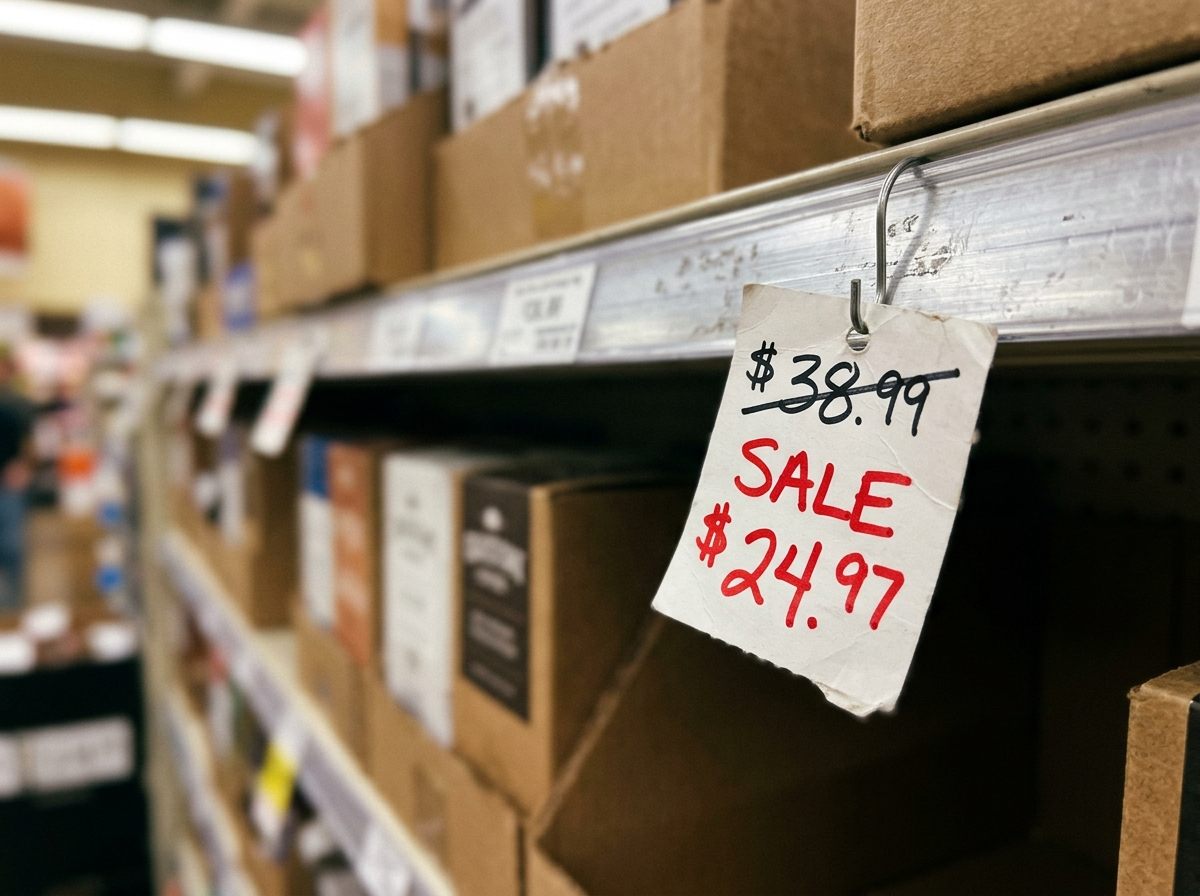
A discount isn't a number. It's a comparison. When a tag says "40% off," your brain doesn't actually process the price you're about to pay — it processes the gap between two numbers, and a big gap feels like a win. The trouble is that the size of that gap is the one thing a store gets to design. Retailers control both numbers in the comparison: the "was" price and the "now" price. That means the headline discount tells you a lot about how a product is being marketed and surprisingly little about whether you're actually getting a good deal.
Once you see this clearly, a lot of "wow" pricing stops working on you. The point of this article isn't that every sale is a lie — plenty of discounts are completely real, and we link to good ones all the time. The point is to separate the genuine price drops from the theater built around them, so you can stop reacting to the size of the discount and start judging the only number that leaves your bank account: the price you actually pay.
The five tricks that make a deal look bigger than it is
None of these are illegal in the general sense, and most are just standard marketing psychology. But they all work the same way — they inflate the "before" side of the comparison or pressure you into deciding before you can check.
1. The inflated "was" price (the anchor)
This is the foundation that all the others are built on. The "was" price — sometimes shown as MSRP, "list price," or "compare at" — is the anchor. Your brain grabs onto it and measures everything else against it. The problem is that the anchor is often a number almost nobody actually paid. A manufacturer's suggested price can sit far above the typical street price, so a product that "normally" sells for $80 everywhere gets a "was $130" tag and a "sale" to $80 that isn't a sale at all.
A close cousin is the brief price bump before a promotion. A price that quietly creeps up for a couple of weeks, then gets slashed back down to roughly where it started, produces a dramatic-looking discount with no real saving underneath it. You don't need to assume bad intent to protect yourself — you just need to stop trusting the strike-through number and look at the price history yourself.
The crossed-out price is a marketing asset, not a fact. It's chosen to make the sale price feel generous. Treat it as advertising copy, because that's exactly what it is.
2. Manufactured urgency
Countdown timers, "deal ends at midnight," "flash sale — 3 hours only." Urgency is engineered to short-circuit comparison shopping, because comparison is the enemy of an impulse buy. If you genuinely believe the price vanishes in eleven minutes, you won't open a second tab to check whether it's actually a good price — you'll just click.
Here's the quiet truth about most of these timers: they reset. The "flash sale" that ends tonight is frequently back next week, sometimes at the very same price, occasionally lower. A timer that restarts every time you reload the page isn't measuring a real deadline — it's measuring your hesitation. Real, hard deadlines exist (genuine clearance, a discontinued item, a true door-buster in limited quantity), but they're the exception, not the default.
3. Scarcity cues
"Only 3 left in stock." "12 people are viewing this right now." "Selling fast." Scarcity works on the same nerve as urgency, but it targets fear of missing out rather than fear of a deadline. The "only 3 left" counter may reflect real inventory — or it may be a display setting that shows a low number to everyone, all the time, regardless of how many are actually in the warehouse.
The "X people viewing" widget is even harder to verify, and there's rarely any way for you to confirm it's tied to anything real. The honest response is the same either way: scarcity is a reason to check the price faster, never a reason to skip checking it. If the deal is good, it's good whether two people or two hundred are looking at it. If it's not good, no amount of "selling fast" should change your mind.
4. Bundle and "% off" math that hides the per-unit price
"Buy 2, get 1 free." "Save 30% when you spend $90." "3 for $25." Bundles and threshold discounts feel like savings because they're framed as savings — but they quietly change what you're buying. A "buy one get one" only helps if you actually wanted two. A "spend $90 to save 30%" tempts you to add a fourth item you didn't need just to clear the threshold, which means you spent more, not less.
The fix is boring arithmetic that marketers hope you skip: divide it out. What is the price per unit, per ounce, per roll, per serving? A "bigger value" multipack is sometimes more expensive per unit than the regular size sitting right next to it. The headline percentage is loud; the unit price is quiet and true. Trust the quiet one.
5. Coupon theater
Then there's the choreography around coupon codes. A checkout box that promises a discount "if you have a code" creates a small panic — am I leaving money on the table? — and conveniently, a code that "works" is almost always findable, because it's effectively permanent. A 15%-off code that's existed for two years and applies to every order isn't a special offer. It's just the real price, wearing a costume.
Browser coupon tools play their own version of this. Many genuinely surface valid codes and save you a step, and we cover which ones earn their keep in our piece on coupon apps and extensions. But some "auto-apply" tools mostly take credit for codes that were already public and one search away — popping up a celebratory "we saved you $6!" for a discount you'd have gotten anyway. The savings can be real; the heroics are theater.
How to actually tell if a discount is real
Seeing through the tricks is half the job. The other half is a short, repeatable routine you can run in under a minute. None of it requires being a hardened cynic — just a habit of checking the right number instead of the loudest one.
Look up the item's price history. This is the single most powerful move, because it neutralizes the inflated anchor completely. Price-history trackers — tools in the spirit of camelcamelcamel or Keepa, which chart what a product has actually sold for over time — let you see whether today's "lowest ever!" is genuinely low or just a return to last month's normal. If the "sale" price is sitting right where the line has hovered all year, the discount is cosmetic.
Ignore the strike-through and judge the absolute price. Cover the "was $130" with your thumb, literally if you have to. Ask the only question that matters: is this price — the $80, the $25, whatever you'd actually be charged — a price you're happy to pay for this thing? A 70%-off tag on something still overpriced is worse than a 10%-off tag on something genuinely cheap.
Compare across two or three retailers. A thirty-second check across a couple of other sellers tells you more than any badge on the page. If the "exclusive deal" matches what three other stores charge at full price, the exclusivity is the costume again. This is also where you'll catch the bundles — the multipack that looked like a steal often loses to a single-unit price somewhere else.
Do the unit-price math. Per ounce, per count, per serving. Most grocery and warehouse shelves now print unit prices precisely because they cut through bundle confusion — use them, and bring the same habit to anything online where the listing won't do the division for you.
Walk away from the timer. The hardest one, and the most freeing. When you feel the clock pushing you, close the tab and come back tomorrow. The overwhelming majority of "expiring" deals are still there, and the ones that genuinely aren't usually return on the next cycle. If you want to take this further, timing matters enormously — we break down the best time to buy almost everything, from electronics to mattresses to airfare, so you're shopping on the calendar's terms instead of the countdown's.
Run those five checks and the entire apparatus of fake urgency loses its grip. You're no longer comparing two numbers the store chose for you — you're comparing the real price against the real market and your own real budget.
Here's the encouraging part: you don't have to become a suspicious person to shop well. Good discounts are everywhere, and skepticism isn't about assuming everyone's lying — it's about refusing to let the size of a number decide for you. Once you train yourself to glance past the strike-through, check the history, and ignore the clock, the genuine deals stand out more clearly than ever, and the theatrical ones simply stop landing. You end up spending less and second-guessing less, which is the whole point. Buy the things you were going to buy anyway — just at a price you chose with your eyes open.